
By T.K. Wilson
Every so often in my circles, a debate will rage- Is Gaston from Beauty and the Beast *REALLY* a villain? Usually, I roll my eyes and move on with my life; the pro-Gaston crowd is full of people who think they’re the cat’s pajamas and my little objections won’t change anyone’s minds. But this time the debate centered around the Beast himself.
Now, the main thing about this debate is that it’s people who are only really familiar with the Disney movie arguing about the Disney movie and not speaking as people who are familiar with the fairy tale and folklore in general. To be honest with you, these people are unqualified to discuss this subject. Disney is hardly scholarly. I don’t say this to be snooty or snobbish… though no matter what I do, it’s gonna look like that, so I’ll roll with it.
First, allow me to define two terms I’ll be using: Faerie. Faerie is both the various races of magical creatures and the world they inhabit. My Celtic ancestors believed that Faerie was everywhere, on hills, in caves, everywhere you looked. You could go around a large rock, an ancient tree, and be in the world of Faerie, where you had to be very, VERY careful.
The second term is geis. This Gaelic word means a ceremonial law or taboo and it’s accompanying curse or consequence. Why I’m using this word will become clear later.
Now, let’s look at the original story of Beauty and the Beast. This translation is a very fine one and based on the original novel by Madam Gabrielle-Suzanne de Villeneuve.
Read it and come back, I’ll wait.
You’re back? Okay, good!
Now, when Beauty’s Father finds the Beast’s palace, he finds it in full summer bloom in the depths of winter. The place is laid out for him, with comfortable lodgings and plentiful food. Of course, to be hospitable was customary in the human world at the time… but of utmost importance in Faerie.
When we find a benevolent Faerie King in stories or literature, he is usually presiding over a bountiful feast in the midst of endless summer. Like our friend the Beast, he makes the stranger welcome and gives him the finest of everything, even favorites of the guest. (Whether you should eat the food is always up for debate, but for now, let’s say it’s perfectly safe to do so.) Offering such dainties is proof of generosity, an essential quality the Faerie folk prize. But there is also a warning.
Faerie may seem lawless to outsiders, but in order to function well, it depends on rules and laws, one of which is to only take what you’re offered. Beauty’s Father of course was offered much, but decided, not thinking the harm, to take something that was not offered to him: the roses. It was this transgression that earned him the Beast’s wrath; this is why he calls the Father ungrateful and why he demands something to repay this theft.
It may seem harsh to demand a human life for a flower, but that ALSO goes back to Faerie understanding of the world. Everything is equal, it doesn’t matter how Humans see it. Beauty in the form of the rose was taken, therefore another living beauty must be offered.
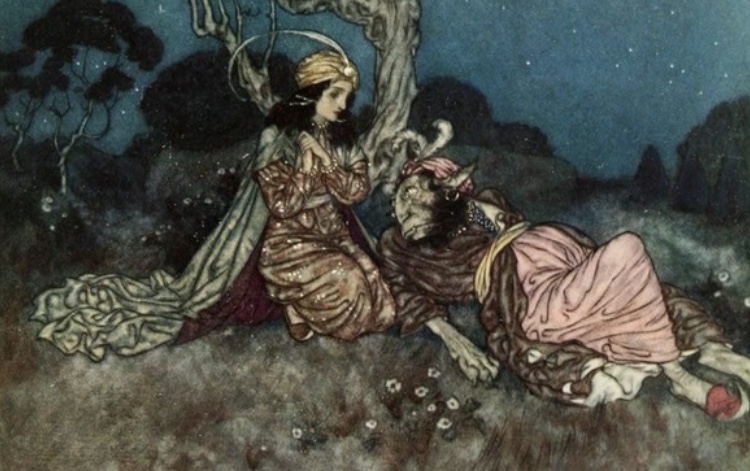
Like Vampires, Faeries can only have power over a person if they, *or a representative of them* give their full consent. The Father’s word was fulfilled the requirement, but the Beast is just, he wants to give Beauty the full choice in this matter. When Beauty, full knowing what she was walking into, comes to take her Father’s place, she give her consent to being in Faerie. But here’s the kicker: the Beast is the Faerie King; he can do as he pleases here, and what pleases him is to give *Beauty* his power. In some versions, this verse appears before Beauty: “Welcome Beauty, banish fear/ You are queen and mistress here/Speak your wishes, speak your will,/Swift obedience meets them still.”
Moving now from Mme. de Villeneuve and Mr. Quiller-Coach, in the account put together by Frenchwoman Stéphanie Félicité, comtesse de Genlis, we find the Beast is ruler of a true Court. In The Beauty and the Monster the Beast is ruler over not just a tribe of various animals, but real humans. In this version, the Beast carries off Sabina (the Beauty) and her best friend Phedima to save Sabina from a loveless arranged marriage. When the girls arrive at his palace, over the door is written “For All Who Are Unhappy”, unhappy in this case meaning luckless or in bad circumstances. This gracious Faerie King (in the text called a Genius, a word from Latin meaning the embodied spirit of a place, a description which could fit faeries very well) has opened his doors to everyone who needs his protection.
Now, the question might arise, if the Beast is so powerful, why can’t he just TELL Beauty what’s going on? Well, that goes back to one of the other laws of Faerie, known as geis, or plural geasa. These are taboos governing the conduct of heroes or royalty, and someone under a geis is honor bound to follow the conditions of this taboo. For instance, Cu Cuchulain was under a geis to never eat dog meat, as it would be eating his namesake. Certain translations of Beauty and the Beast leave the Beast literally unable to say why he is the way he is. In any other case, it is a geis laid on him not to say, or it would bring ruin upon him.
If you look at MORE than the Disney movie, the story of Beauty and the Beast has several layers of meaning. Unfortunately, because of the inexorable grip the House of Mouse has on the fairy tale market, you have to dig for those deeper layers. Reducing a story to it’s barest bones has it’s merits when you’re trying to make a 90 minute movie, but continuing to act like that’s all it is… that’s an issue for me.
 LogoSophia Magazine