

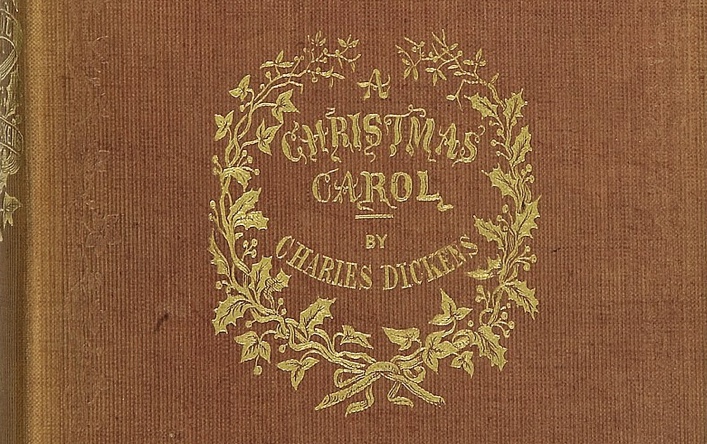
A Christian Analysis of A Christmas Carol
By Ruth Amsden
Since its publication in 1843, Charles Dickens’ Christmas classic A Christmas Carol has enjoyed unbroken popularity. Many film adaptations have been made, introducing the great words of Dickens to an audience that might not otherwise have become familiar. It is a favorite Christmas tradition of countless families to listen to great actors like Sir Patrick Stewart read the work aloud. Yet despite its popularity, Dickens’ classic has been critiqued as too sentimental. From a Christian perspective, it has been criticized for not being explicitly Christian enough in its redemption narrative. Yet if we take A Christmas Carol out of its Victorian-era Christian context and attempt to evaluate it by the secular and commercial standards of today’s postmodern society, we reduce the text to a saccharine, “feel-good” pot-boiler. This essay will trace the Christian and Biblical influences on the text in an attempt to prove that A Christmas Carol is a story of the life of Ebenezer Scrooge transformed by Christian love.
Stave One
Ebenezer Scrooge, a “tight-fisted hand at the grindstone, a squeezing, wrenching, grasping, scraping, clutching, covetous old sinner,” appears upon introduction to be beyond the reach of love, human or divine. Scrooge is an object lesson for St. Paul’s exhortation to St. Timothy:
“They that will be rich fall into temptation and a snare, and into many foolish and hurtful lusts, which drown men in destruction and perdition. For the love of money is the root of all evil, which while some have coveted after, they have erred from the faith, and pierced themselves through with many sorrows.”
Scrooge’s conversation with his nephew shows us just such a man: a man who “does not make merry at Christmas” and whose wealth provides no warmth and comfort. Nor does his wealth make life warmer or more comfortable for those unfortunate souls in his employ, in his debt, or in his family.
Scrooge has shut his heart away from love, both human and divine; but is he irredeemable? A clue may be discovered in the first name Dickens chose to give his irascible character: Ebenezer. In the Bible, names of people and places are highly instructive, and Dickens would probably have been more literate in Biblical name meanings than many of us are today. Ebenezer translates into “Hitherto hath the Lord helped us.” Scrooge is not, as yet, beyond the reach of divine love; but as the ghost of his deceased partner warns him, he may soon be.
Marley’s ghostly visit to Scrooge is reminiscent of the story of Dives and Lazarus. Dives, the rich man, did nothing to ease the suffering of Lazarus, the poor man, during their respective lifetimes. After they both died, Lazarus found himself comforted by Father Abraham, and Dives found himself tormented in Hades. Dives begged Abraham to visit his brethren and warn them of the judgment that should follow if they did not repent of their sin; but Abraham refused, saying, “If they do not hear Moses and the Prophets, neither will they be convinced if someone should rise from the dead.”
Dickens evidently drew inspiration from this terrible story, and posed the question, What if one could rise from the dead to warn the living? At first, it appears that Abraham was correct: Scrooge remained unconvinced for a time, even by the ghostly appearance of his partner.
From an historical perspective, the Gospel of Salvation was more widely available to the common man than ever. The Great Awakening one hundred years before A Christmas Carol was written had brought Christianity out of the high church and into the fields and slums, to the poorest and neediest people. As Dives and his brothers were well aware of the teachings of “Moses and the Prophets,” so Scrooge would have been well aware of the teachings of Jesus and the Apostles. This is apparent from Marley’s remorse that he has never raised his eyes “to that blessed Star which led the wise man to a poor abode.” Marley was referring to the story of the first Christmas, to the Star that guided the Magi to the home of the Christ child. And Scrooge’s nephew makes passing mention of “the sacred name and origin of Christmas.” Scrooge was not ignorant; and unlike Dives, there was a hope and a chance for his salvation.
Stave Two
There can be no salvation without introspection and repentance. In order to understand why he had ended up alone and friendless, it was necessary for Scrooge to reflect upon his past life, with the benevolent aid of the Ghost of Christmas Past. Scrooge’s past reads like a commentary on Jesus’ warning:
“No man can serve two masters: for either he will hate the one, and love the other; or else he will hold to the one, and despise the other. Ye cannot serve God and mammon.”
Scrooge was not without role models who could have shown him the way to averting a childless, loveless old age. His father, his sister Fan explained, had undergone a great change, and “was so much kinder than he used to be, that home’s like heaven!” Mr. Fezziwig, his employer, delighted in spending his own money for the delight of his employees. Scrooge’s unnamed fiancée tried to warn him that the idol of gain had taken possession of his heart, and stolen his affections from her. His nephew offered the familial love that Scrooge shut out of his heart.
But while Scrooge’s past could not be changed, remembering those role models was part of his journey to redemption and repentance. Regret and remorse alone, however, are not enough to effect repentance and redemption; Marley’s restless torment illustrates that clearly. Thus, the Ghost of Christmas Past served only to soften the heart of Scrooge in preparation for the Ghost of Christmas Present.
Stave Three
The Ghost of Christmas Present shows Scrooge that the true meaning of Christmas is not the trimmings, the tinsel and feasts and sentimental family gatherings, the commercialism in stark contrast to desperate poverty. The true spirit of Christmas can be found in a little child. Jesus Christ, the “mighty founder” who “was a child himself,” was born into desperate poverty, with only pain and death to look forward to, in order to bring love and light into the world that was sorely lacking.
Tiny Tim, with his simple child-like faith and loving heart, is a sort of Christ figure, a reminder that the Christian faith is not in a better world here and now, but in a Savior Who was born as a little child to bring hope and healing for the resurrection life beyond this one. Christ did indeed heal many who were disabled. But there were many people, like Tiny Tim, who did not receive healing, but who continued to trust and hope.
Tiny Tim’s story and its effect upon Scrooge is a commentary upon Christ’s words, to which Dickens later makes reference:
“And He [Jesus] called to Him a child, and placed him in the midst of the disciples, and said, ‘Except ye be converted, and and become as little children, ye shall not enter the kingdom of Heaven. Whosoever therefore shall humble himself as a little child, the same is the greatest in the kingdom of heaven.’”
Anyone who had made the acquaintance of a particularly endearing child cannot wonder that even Scrooge’s withered heart melted at the sweetness of Tiny Tim. Throughout history, the appeal of innocent children has brought out the deepest humanity in the most hardened souls, and the vilest iniquity has been that which causes the suffering of innocent children. In the end, Scrooge has painfully learned the lesson of Christ’s words: “Despise not one of these little ones: for in heaven their angels do always behold the face of my Father.” By the end of his sojourn with the Ghost of Christmas Present, Scrooge is well upon his way to repentance.
Stave Four
Repentance requires a most painful life event: the dark night of the soul, and it is to that necessary night that the Ghost of Christmas Yet To Be guides Scrooge. In order to truly repent, Scrooge must see the unvarnished picture of what his life and death will be like if he does not repent. The fourth stave is a commentary upon Christ’s solemn words: “What shall it profit a man if he gain the whole world and lose his own soul? And what shall a man give in exchange for his soul?”
Scrooge has inflicted untold suffering upon countless people at his mercy in his relentless quest for material gain. He has found, as his fiancée prophesied, that all his profit has not cheered and comforted him, as she would have done. He has served sin, and mammon, all his adult life, and sin will surely pay its wages: death. And not just any death. The Ghost of Christmas Present, after all, showed Scrooge that a cheerful bed of illness and death is possible. Scrooge’s death, unless he turns from his sin and greed, will be “unwept, unhonored, and unsung.” He will be an illustration of St. Paul’s exposition: “The sting of death is sin.”
Scrooge has, at last, repented. “I am not the man I was,” he pleads with the Ghost of Christmas Future. He has turned from the idol of gain to the spirit of Christmas. He promised, “I will honor Christmas in my heart, and try to keep it all year.”
But in his agony of spirit, he fears that his repentance may have come too late.
Stave Five
As in Modest Mussorgsky’s tone poem “Night on Bald Mountain,” a long dark night of terror ends in dawn and church bells for Ebenezer Scrooge. He has learned the lessons of the past, the present, and the future.
Christians might argue that the work of ghosts and spirits did the work of guiding Scrooge to repentance and thus, his was not a true conversion. But St. Peter reminds us that God has used unconventional means of communication throughout history: “But [Balaam] was rebuked for his iniquity: the dumb ass speaking with man’s voice forbad the madness of the prophet.” If God can speak to a prophet through a speechless donkey, certainly He can speak through ghosts.
Evangelicals would argue that the conversion was not a true one because the main tenets of the Gospel, the sacrificial death and resurrection of Christ, was not placed at the center of Scrooge’s transformation. But Christ promised, “By their fruits ye shall know them,” and Scrooge proved by his generosity, love, gratitude, and joy that his repentance had not been a human fear of death but a true inward transformation. His life post-conversion proved that his had been no temporary conversion but a genuine work of redemption.
 LogoSophia Magazine