

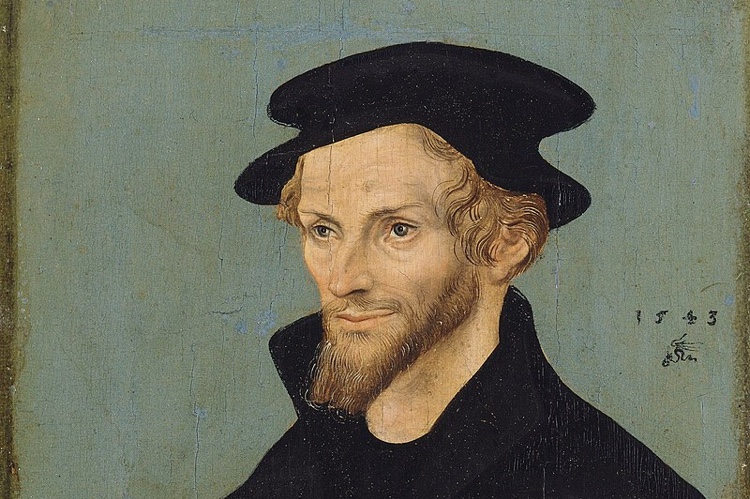
By Ian Wilson
The Lutheran Church’s first systematic theologian was born on February 16th, 1497, in Bretten, Germany. He was given the name Philip Schwarzerdt, but at the urging of his uncle, Johann Reuchlin, he changed it to the Greek name, Melanchthon, to reflect his status as a scholar. Johann Reuchlin had a significant influence on Melanchthon; he was a humanist scholar, and often questioned Catholic doctrine. Melanchthon came to believe that the church had fallen into certain errors. While he respected Aristotle, he believed that the church relied far too much on his writings in interpreting Scripture.
Melanchthon proved a brilliant young scholar, and was offered a position at the University of Wittenberg in 1518, when he was only 21 years old. This was only a short time after Martin Luther published his 95 Theses, and the two soon became acquainted.
Melanchthon considered himself Luther’s pupil, and Luther considered Melanchthon one of his closest friends. Though the two often disagreed on certain principles, they never ceased to be friends and allies. Luther was very direct and blunt in his rhetoric, often inviting conflict, while Melanchthon was more interested in finding consensus and nuance. Melanchthon frequently traveled with Luther to various debates and even accompanied him to his famous trial at the Diet of Worms as his assistant.
In 1530, out of concern over the invading Ottoman empire, Charles V, Holy Roman Emperor, called together all the German theologians, Protestant and Catholic, to bring some form of unity in the face of this threat. In response, Melanchthon drafted what became known as the Augsburg Confession. This confession of faith was intended to bring synthesis to Protestant and Catholic theology, and unifying these branches of Christianity. This effort failed, but the Augsburg Confession was adopted as one of the central documents of Lutheranism.
Melanchthon enjoyed a happy marriage to Katharina Krapp, the daughter of Wittenberg’s mayor, with whom he had several children. Melanchthon was described as “sickly” or “scrawny” and suffered from certain health conditions that plagued him throughout his life. After Luther’s death in 1546, Melanchthon found himself alone in the supreme task of keeping the Protestant movement in some semblance of unity. He was often criticized by fellow Lutherans for his view toward consensus and compromise. Nevertheless, Melanchthon continued the cause of the Reformation until his death from fever 1560. It is said that he was unconcerned for his own life, but only thought of the future of the church.
May we, like Melanchthon, have a view toward consensus and unity without compromising on principles.
 LogoSophia Magazine