

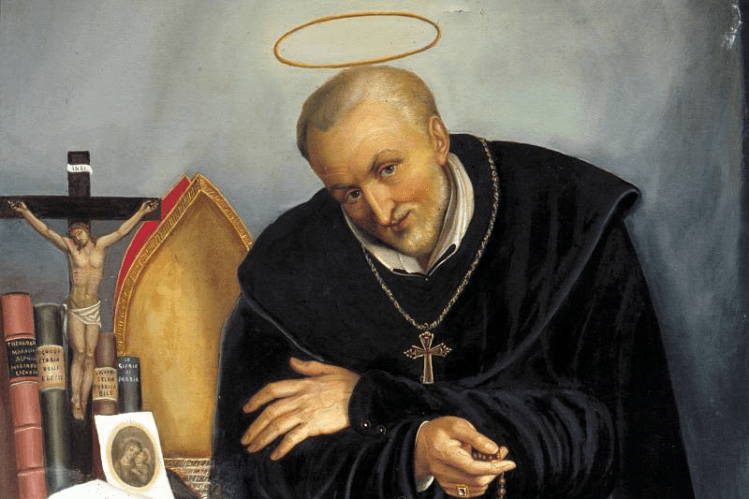

by Ian Wilson
Beloved by the poor and downtrodden, St. Alphonsus Liguori was born in rather privileged circumstances. Born in Naples, Italy in 1696 to a captain in the Royal Navy and a devout mother of aristocratic lineage, Alphonsus was raised in the nurture and admonition of the Lord. As a youth, he joined the Confraternity of Our Lady of Mercy, where he helped to care for the terminally ill. However, following the wishes of his father, Alphonsus went to school to become a lawyer. It was said by his contemporaries that he never lost a single case.
During this time, Alphonsus became rather involved in the affairs of this world, neglecting prayer and other acts of piety in favor of stage plays, banquets, dances and other frivolities. These, however, left him feeling hollow. Then came the most important case of his life; a lawsuit between two noblemen, in which Alphonsus was leading counsel (we do not know for which side). However, due to a small oversight, Alphonsus lost his case.
Crushed at the loss, Alphonsus quit his law practice and devoted himself entirely to prayer, seeking God’s will for his life. Then the answer came in a vision, in which he heard the interior voice from God telling him to leave this world behind and devote himself to the work of God. Alphonsus obeyed, seeking ordination as a priest. This did not please his father, but after months of argument, he allowed Alphonsus to join the priesthood. He was ordained in 1727.
Alphonsus became increasingly drawn to missionary work. This comfortable life as a popular priest in his father’s house did not suit him; he needed to be out among the common people. He became involved in the mission work of Matthew Ripa, “Apostle to China” in whose company he met one of the dearest friends of his life: Father Thomas Falcoia.
Falcoia, an elderly man by this time, had a profound influence on the young Alphonsus. Falcoia had received a vision several years prior of a fraternity of men dedicated to living out the virtues of Christ in the world, serving the poor. His attempts to form such a community had been fruitless, however. Nevertheless, he had re-founded an order of nuns in the mountains of Scala, among whom was Sister Maria Celeste. Celeste had had several visions concerning a new religious community, which she had written down and shown to Falcoia. Falcoia realized that this new rule was exactly what he had tried to start for years.
Meanwhile, Alphonsus had became a brilliant theologian and gifted preacher of the Word. He was popular and well beloved by all who had the pleasure of hearing him speak. His popularity, however, led to many demands on his time and energy. Greatly fatigued by his labors, Alphonsus fell ill. He and his companions went on retreat to the mountains of Scala to recover. While there, Alphonsus grew restless and began preaching to the farmers and goat herders of the region, who were eager to hear his words. He was so successful that the bishop of Scala begged him to stay and minister.
On the eve of St. Francis’ feast day, Falcoia had a vision of the Lord Jesus with St. Francis on his right hand and a priest on his left. The priest was none other than Alphonsus. Jesus explained that Alphonsus was to be the leader of the new order. Once Falcoia had made known his vision to Alphonsus, the Congregation of the Most Holy Redeemer was formed.
There was great difficulty in the beginning. Alphonsus thought himself unable and unworthy to the task of heading a new order, and recommended other, supposedly more capable priests to the position. He lost friends, and faced internal opposition from the church, and external from the state, but through it all, he stayed firm to the calling to which he had been called. In 1762, Alphonsus was promoted to Bishop, which meant he had even more responsibilities, aside from his theological writings and missionary work.
Though popular among common people, Alphonsus had made several enemies within the government due to his strict adherence to his principles. Several attempts were made on his life; all of which he survived, but then there were his frequent, severe illnesses. He received Last Rites no less than eight times during his tenure as bishop. Late in life, he even fell out of favor with the pope, but he was later pardoned and declared “venerable” upon his death. At one point, the order which he had started fell into pieces. It was later reunited after his death, as the saint had predicted.
Alphonsus was a lawyer, even after becoming a theologian, and his treatises on moral theology have been studied extensively from his day until now. He was a mystic, and experienced many visions, miracles and other ascetic experiences. However, he was a passionate soul, and often struggled with anger. He was also prone to scruples; he feared that he had not done enough for his Lord and his Church, and that he was destined for damnation. But his friends would often read to him the words of grace and assurance that he himself had written. His physical ailments had rendered him nearly paralyzed in his later years, causing him great suffering. But through it all, he never lost sight of the goal, which was his Almighty Savior.
Finally, after a long life of exhausting service, severe persecution of body, soul and reputation, Alphonsus Liguori passed from this realm into eternity in August first, 1787.
 LogoSophia Magazine