
By Ian Wilson (G)
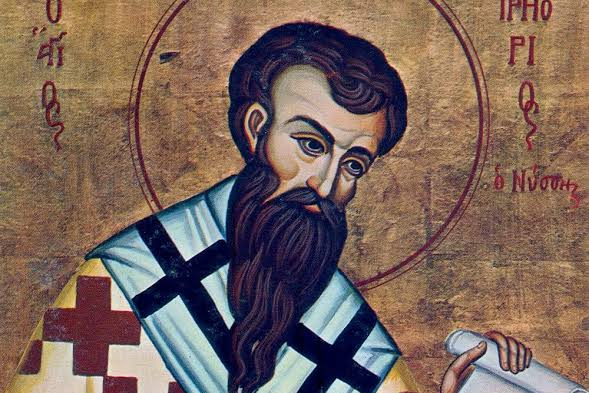
Considered the most astute of the three Cappadocian Fathers, the man who would become Gregory of Nyssa was born into a large, devout Christian family sometime in the fourth century. His older brother was none other than Basil of Caesarea, another one of the Cappadocian Fathers. Together with Gregory of Nazianzus, the three teachers synthesized and defined Christian theology in the East. Their influence is still felt today in Eastern Orthodoxy.
Little is known about Greory of Nyssa’s early life. It is believed that Basil was the only one of his siblings to have obtained a formal education, and tutored his brother at home. He must have been an excellent teacher, as Gregory grew to be an intellectual giant, blending together Greek and Jewish philosophy and Christianity into a seamless fabric. One can find the influence of Plato, Aristotle, the Stoics and Philo, as well as predecessors in the Christian tradition, such as Origen, in Gregory’s written works. However, Gregory was also greatly influenced by the piety of his older sister Macrina, a saintly woman who continued to hold a special place in his life well into adulthood.
Early in life, however, Gregory showed little interest in pursuing a career in the Church; he rather took an interest in secular rhetoric, which greatly influenced his work. There is even some evidence that Gregory was married. However, through the influence of his older brother, his sister and his friends, Gregory’s reluctance was overcome, and he pursued a career in the clergy, eventually ascending to the office of Bishop.
St. Basil’s letters seem to indicate that while Gregory was not lacking in zeal for souls, he was lacking in the administrative skill required of a bishop. He occasionally complained of his brother’s interference in his own diocese.
Then in 379, tragedy struck. Both his brother Basil and his pious sister passed into eternity, leaving Gregory alone to define and defend Christian orthodoxy. St. Basil had been one of the most ardent proponents of the doctrine of the Trinity, and many feared that the Arian heresy would overtake the church yet again. Gregory saw it as his duty to take up his brother’s cause.
This was the most prolific period of Gregory’s life. He wrote many theological treatises, including the three volume Against Eumonius, a lengthy refutation of Arianism, as well as multiple commentaries on various books of the Bible. Perhaps his greatest work was his Great Catechism, one of the first complete systematic theological works in Christendom.
In 381, he was invited to the Council of Constantinople, which was convened to put the final nail in the coffin of Arianism. This council gave us the final clause of the Nicene creed: I believe the Holy Spirit, the Lord and giver of life, etc. He established himself as a gifted orator at the council, and was in high demand throughout the 380s. About 395, Gregory vanished from history, and we can only assume that he died right around that time period. He left behind a legacy of tremendous theological importance, but above all, he sought to know God, and introduce him to the world.
May we, like Gregory of Nyssa, never tire of seeking God.
 LogoSophia Magazine
Amen. Thank you.
LikeLike