

By Ian Wilson
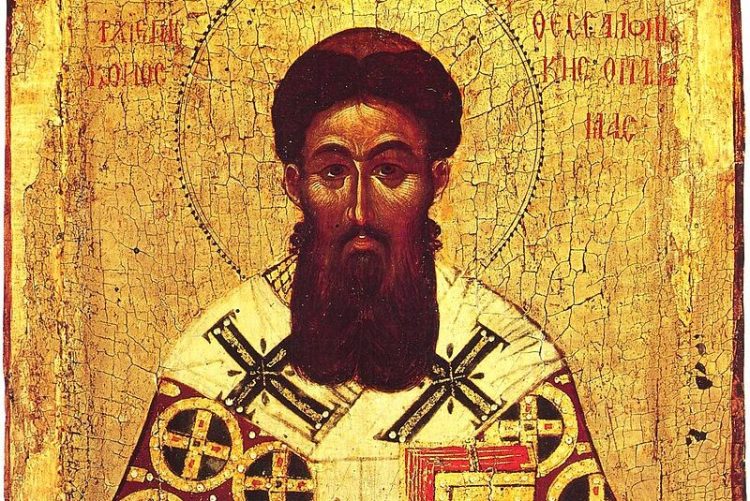
St. Gregory Palamas was a highly influential saint of the Eastern Church, who is best remembered for advancing and defending the practice of hesychasm, or internal prayer. His life and written works have inspired many through the centuries to draw nearer to God in prayer and in an ascetic life.
He was born in the year 1296, the son of a prominent man in the court of Andronicus II Paleologos, the Byzantine Emperor. He was so beloved by the Emperor that when Gregory’s father passed away, Emperor Andronicus took the boy under his wing and gave him the best possible education. Gregory was a gifted student, and mastered every subject given to him.
Gregory, however, did not take the path of government service laid out for him, instead withdrawing to Mount Athos to pursue a monastic life. Gregory applied himself to monastic life as diligently as he did to all his other studies, struggling up the ranks of the monastery. It was here that he first became acquainted with the practice of unceasing mental prayer. This mental prayer, known as “the prayer of the heart” or “hesychasm” (from the Greek word for “quiet”) proved to be the young St. Gregory’s lifeline. He taught many others the practice throughout his life, believing it to be the path to inner peace.
Then in 1326, due to the threat of the invading Ottoman Turks, Gregory and his brethren fled to Thessalonica, where he was ordained a priest. He continued his ascetic lifestyle, only coming out to preach on Saturday and Sunday, the rest of the week being spent in solitude and prayer. He was known as a gifted theologian and preacher.
In 1330, an event happened which put Gregory in the spotlight. A theologian, orator and astronomer named Barlaam arrived in Constantinople, where he began to dispute with the monastics and theologians there over the matter of hesychasm. He ridiculed the monks over the practice, believing that they were attempting to perceive the essence of God, which no man has seen. The monks compelled Gregory Palamas to reply to Barlaam, which he did in his work Triads in Defense of the Holy Hesychasts in 1338. He continued to verbally debate Barlaam, asserting that though a mortal cannot see the essence of God, he makes Himself known through his uncreated, immaterial energies, which we can see.
Aside from this, Gregory endured various trials of his faith, even being imprisoned by his own hierarchy for preaching hesychasm. According to them, he was too disruptive to church order to be allowed to be free. He was eventually released when the church determined the orthodoxy of his teachings. However, he was kidnapped by the Turks and held for ransom in the 1350s. He continued to preach during his captivity, much to the consternation of the Turks, who severely beat him for preaching the Gospel. After a year in their captivity, his ransom was paid, and Gregory returned to his work.
After many long years of service to God, Gregory Palamas went on to his eternal reward on November 14, 1368. May we all have the same convictions as Gregory, and pursue holiness and union with God with the same vigor.
 LogoSophia Magazine