
By Amanda Pizzolatto
It’s that time of year again. The time of year for wonder, traditions, family, friends, precious moments, heartache for the ones who have passed on, joy, tears, laughter, and quite possibly some of the worst takes this side of the galaxy has ever seen. No, seriously, some takes just makes you wonder if they actually watched the movie or they are just parroting someone else’s bad takes and you have this really long train of bad take telephone running around getting whatever attention it can get, because apparently bad attention is just as good as good attention these days. Apparently they only want those five minutes of fame and don’t care if they aren’t remembered for anything else, at least anything worthwhile. Spicy take, I know. Rather unusual for me, if I do say so myself. But you know what? I am actually very grateful for it. Because thanks to these bad takes, I have successfully rewatched It’s a Wonderful Life and debunked every one of them. Well, the ones I’ve seen on Twitter so far, anyways. I had to stop because some got so weird that I was questioning their thought processes, and others made me wonder what the heck they were even doing commenting when they don’t even like the movie.
I mean, hey, I get it, you try an old movie and realize you don’t like it. I hope it’s just that movie and that you don’t hate all old movies. There are quite a few gems in there. And just like with movies of today, there’s a little movie for everyone. I’m still hesitant about watching The Breakfast Club and The Godfather myself. I understand those are major influences of many movies and are parodied and referenced a lot (heck, the movie The Faculty is just The Breakfast Club with a kind of Invasion of the Body Snatchers alien invasion), but neither one really interests me. So, I totally understand that not every movie is going to appeal to every person. If you don’t like it, don’t worry about it. That includes Twitter arguments between fans and very bad takes of movies. But, if you are willing to watch it again just to see what I’m talking about, then here are a few things to keep in mind.
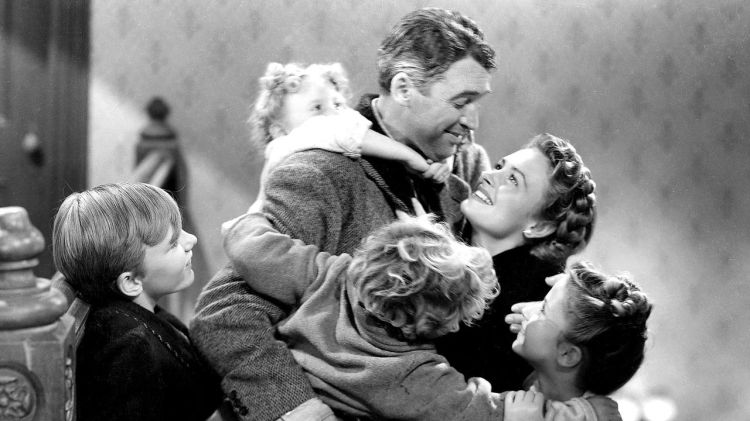
To begin, It’s a Wonderful Life is in fact based on a short story originally named The Greatest Gift, self published one hundred years after A Christmas Carol. It was officially published as a book the following year. Frank Capra saw its potential, and after two years and many name changes – including the title – It’s a Wonderful Life came out and has been a staple Christmas movie ever since. Rightly so, considering not just when it takes place (all on Christmas Eve, we go through George’s life with Clarence right before he confronts George), but also because it was loosely based on A Christmas Carol. Instead of the Ebenezer Scrooge character getting a new look on life, it’s the Bob Cratchit of the story, if you will. George, the family man, the generous heart, who is living paycheck to paycheck, barely able to save anything. Life has been a bumpy ride for him, full of its ups and downs. And it is on one particular Christmas Eve that we see George at his lowest. He has been fighting Potter for so long that he feels burned out. And then for Uncle Billy to lose a whole lot of cash (which is, irritatingly enough, sitting in Potter’s lap) just throws him into a spiral. To top it off, George didn’t actually think of suicide until Potter himself mentions he’s worth more dead than alive (though Potter probably never even considered the thought himself, nor meant for George to commit suicide. It was a mere passing remark, he wanted George ruined, not dead). This then leads us to the bridge, and with George, we are shown the message of the movie. Every single one of us is worth more alive than dead. Not in terms of monetary value, as Potter put it. He, like Scrooge, is only thinking about his love, money. And as the Bible points out, it is the love of money which is the root of all evil. Clarence shows what George has known all along, that people have no monetary value and should be treated like humans, himself included. Of course, the monetary relief did come, thanks to Mary who sounded the alarm. It really just went to further prove Clarence’s point, that he was worth more alive than dead, but the money was just the cherry on top. The main point, as Clarence wrote in his gift to George, that a man who has friends is no failure. This mirrors the lessons the ghosts give to Scrooge.
But then, what of George’s hopes and dreams, his talents? A few people seem saddened that George didn’t get to use his talents, to put them to good use. But that kind of thinking is saddening. It cheapens the hard work and talent he used to keep Bedford Falls a thriving community. It also cheapens the hard work and talent used in other communities, on smaller scale projects or volunteer work. Just because your name isn’t lit up on Broadway Boulevard in Hollywood doesn’t mean it wasn’t put to good use. The worst part is not ever using your talents at all, and George certainly did get to use his. That being said, what do you think his talents were? He wanted to design and build; Bedford Falls got Bailey Park. I’d say that was a pretty good use of his talents there. Don’t you? Other talents include his kindness, mercy, and generosity. Or do you think like Potter, that talent should only be used to bring in money? That certainly won’t get you far, well, according to the Ghosts of Christmas and Clarence. But that’s if you get far merely using your own talents as is. An artist’s job nowadays seems to be in the process of being made worse due to A.I, a writer’s job too, at that. What good is a talent if we’re adamant about letting robots and computers do the work for us? If you’re against A.I. taking over the jobs of artists and writers, then I hope you can understand why George’s talents were put to good use in Bedford Falls. But if you’re all for it, rather than having it just be a tool used by artists, then you’re a hypocrite, crying about how George didn’t put his talents to good use in the wider world but going quiet when the talents of artists and writers are tossed to the side in favor of shiny new equipment. Or are you just concerned with the fact that he didn’t get to travel, as he wanted to do?
One question should clear that up. Is George dead by the end of the movie? Then, with that twenty-five grand that Sam Wainwright wired to him, he can take that grand, world tour of a honeymoon that he didn’t get with his wife. Who, by the way, had told him to just stay in the car and go rather than see what was wrong with the Bailey Building and Loan. But George, on his technically fourth chance to travel, chose not to. Yes, that was his fourth chance. His first was when his father had a stroke. Technically, that doesn’t quite seem like it was much of a choice, but it was since he was all ready to go. He was basically coerced into the second one – it was either he be on the board or go travel. His third was when Harry came home from college. Harry does state that he will take over the business so George can finally go travel like he’s always wanted. But he went and asked about the job offer Harry’s father-in-law had in store for him and decided against going, again. I would not be surprised if Harry told his father-in-law the whole situation and he quite possibly was willing to wait a few years so George could get his travelling done. Then George got married himself, and nothing beats a world trip for a honeymoon. But as I mentioned before, when it came time to choose between the Building and Loan or travel, he chose the business. He himself might not be able to say why, but that probably ties in with another one of his talents, leadership. Now, yes, he didn’t lead a team of explorers into the African savanna or the South American jungles, but he led the town of Bedford Falls against Potter’s materialistic control. George, and his father, both saw the humanity in the townsfolk of Bedford Falls and refused to let Potter exploit them. Like Scrooge’s nephew, Fred, had told him about Christmas, while it didn’t put more gold into his pocket, the spirit of generosity did George – and Bedford Falls – quite a bit of good. I’d say a whole lot of good as George built good homes for people to thrive in. And in this day and age, with all the news of cities trying to get rid of spots where the homeless could stay in parks and whatnot, George Bailey is the hero that many would look up to and follow without question.
My other issue with that line of thinking is that it puts life on a timetable. Must we all have our dreams fulfilled by the time we are twenty years old? Some of us don’t even know what we want until later in life, or our dreams change as we age and what we wanted in our twenties isn’t what we want in our forties, or even really what we need. Travelling is a luxury, as much back then as it is now. Not everyone has the ability to travel, much less the funds. Not to mention, it sounds like you’re looking down on people who haven’t gotten it all together and achieved their dreams by the same time you did. As someone whose own dreams have not been fulfilled, hearing that chips away at the hope that it will still happen, just later on in life. Why say something like that, especially since we know that George is still alive at the end of the movie and will probably still get many chances to go travel? Traveling in your sixties doesn’t mean it will be less fun than in your twenties. He will no doubt get to travel. It was just that Bedford Falls needed him more.
Now this leads me to one other problem I had. Someone mentioned that they didn’t like the dichotomy of the wide world equals false and the home, sweet home being true. I have no idea where that dichotomy came from, or what part of the movie gave that impression, but we already have two counts against that: Harry Bailey and Sam Wainwright. Both leave Bedford Falls and both seem to be doing very well indeed. Sam Wainwright in fact is probably the richest of all of George’s friends and is travelling the world, something George has always wanted to do. If anything, that goes to prove that getting out of Bedford Falls would have seen his dreams come true even faster for, as Uncle Billy pointed out to Potter, if Harry could do it, so could George. True, his ear might have given him a few problems where it concerns work, but he would have powered through it. So then, what is the dichotomy?
Since this is loosely based on A Christmas Carol, it stands to reason that its dichotomy is the same as Carol. This is where I would bring in Scrooge, to stand in the middle of the dichotomy, as he alone seemed to need to make that choice, and the dichotomy is Potter and Bailey. More specifically, what the two men believed and represented. Potter is the old Scrooge, that “squeezing, wrenching, grasping, scraping, clutching, covetous old sinner! Hard and sharp as flint, from which no steel ever struck out a generous fire; secret, and self contained, and solitary as an oyster” (A Christmas Carol, p2). Meanwhile, George takes more after Bob Cratchit and Scrooge’s nephew Fred, coupled with the reformed Scrooge after his own ghostly visit. As such, the real dichotomy is their treatment of the citizens of Bedford Falls. While Potter only sees money, George, and his father before him, sees people.
Now, money in and of itself is not evil, evident by the fact that not only does one of George’s closest friends, Harry, and eventually George himself come into a lot of wealth, but also that the Bailey business deals with money. The main issue is how you treat people. George straight up gives us this dichotomy when he turns down Potter’s proposal to work for him: that Potter sees cattle while George himself sees people. And this is where George’s talent for leadership comes in. He alone, it seems, stands up to Potter when no one else will. This is evident in the alternate reality where he wasn’t born as Bedford Falls becomes Potterville. This is also evident in the board meeting we see after Mr. Bailey’s passing, everyone else was basically going to join Potter, until George gave his resounding speech. They also realized they couldn’t stand up to Potter like George could and as such, having George on the board was their requirement if they were to ever consider continuing to fight Potter. The board, here, could be said to represent the rest of us, fickle as we are. We really only follow the path of good if someone else plays the role of leader and leads us down it. Otherwise, it seems we default to the path of least resistance, which turns out to be the bad path. This, then, is George’s talents out in full force and put to very good use. He can get the town to rally around him, he can stand up to Potter and tell things like it is to his face.
Again, while I understand that not everyone likes this movie, a good number of people do, and for good reason. While it did not do well at the theater when it first came out, it has since become a Christmas classic for many families, as closely tied to Christmas as its predecessor, A Christmas Carol, and will continue to do so for many more years. Like with George’s talents, you might not always be able to see its influence at work, but the smaller things still make ripples, and with time, you will see its effects. George didn’t have to go out into the wider world to do great things, he was the great thing, being the epicenter of a ripple effect that led to many lives being saved. After all, many believe George helped even Jimmy Stewart himself, who might have found it therapeutic working on the movie after returning home from the war. I don’t know anything greater than that. Well, Jesus obviously takes the cake, but still, George Bailey is great, it’s just we need to remember that small things are equally as important – sometimes more so – than bigger things.
 LogoSophia Magazine