

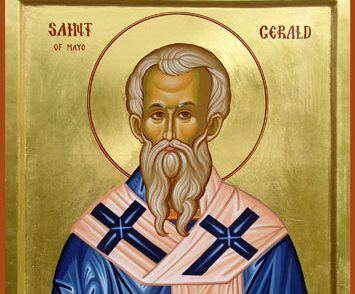
Little is known about this English saint of the 7th century. We do know that he arrived in Ireland in the year 668, not long after the controversial Synod of Whitby. The Council was convened (among other things) to decide the date of Easter; whether the British church would adopt the Roman way of reckoning the date, or the traditional Gaelic way. St. Colman of Lindisfarne vigorously advocated for the Gaelic way, but the Synod decided to side with Rome.
After this, Colman separated himself. He and several of the monks under him, including St. Gerald, departed for Ireland to found a new community. On the island of Inisboffin, St. Colman, his English monks and some native Irish monks founded a new monastery. However, all was not well with the new community. The Irish monks were a highly enthusiastic group, and would spend their summers amongst the people, evangelizing, leaving the English behind to tend the monastery. This created dissension among the monks. St. Colman ended the conflict by founding a separate monastery for the English in Mayo, Ireland. This satisfied both parties, and Gerland became its first abbot. Though young, he was a wise and exemplary leader.
But there was a need in Ireland. With so few available priests, the Irish people had little access to the sacraments. In order to fill this gap, St. Gerald was made a bishop to ordain more priests and get the sacraments to more people.
Historical records disagree on the date of St. Gerald’s passing, but it was either in the year 726 or 731. May we all quietly stand by principals, while still making room for compromise like St. Gerald.
 LogoSophia Magazine