
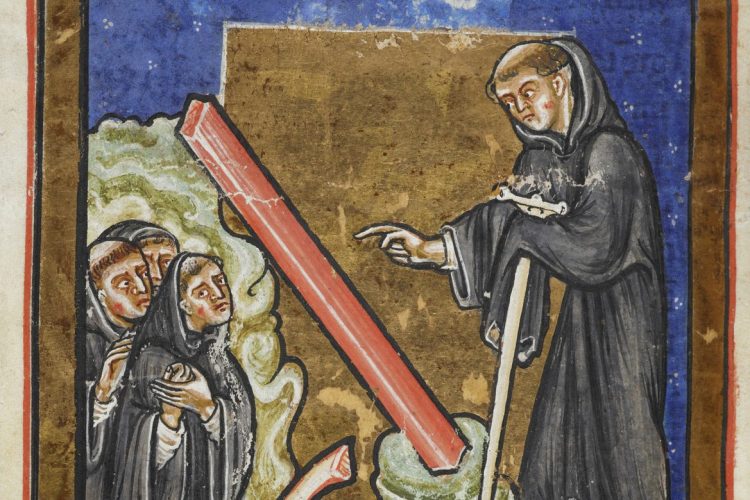
St. Cuthbert of Lindisfarne was born in either 634 or 635 in the kingdom of Northumbria in northern England, near the Scottish border. Nobody knows exactly what his family background was, but the important thing is that Cuthbert was a cheerful boy, pious, and good with animals, much like St. Francis. He also served in the Northumbrian army, fighting against the pagan Mercians. After his time of service to the king, he returned to his job watching sheep, which was his occupation before the war. When he was seventeen or eighteen, he saw a vision that would change his life forever.
One ordinary summer night, August 31, to be precise, Cuthbert saw angels descend from the heavens, receiving a bright soul. The next day he learned of the passing of St. Aiden, Bishop of Lindisfarne and reasoned it was his spirit he saw being carried away to heaven. Within the next year, Cuthbert became a novice monk at Melrose Abbey, impressing everyone with his joyful demeanor and natural humility.
After surviving the wars with the Mercians, Cuthbert also survived an outbreak of the Plague which killed the Prior of Melrose, leaving the position to Cuthbert. Though he too fell ill, he survived and with his new immunity set to work in ministering to the sick. He also undertook missionary journeys to the villages around Melrose, making sure not to miss even a remote place on the map.
Another big change came when the churches of Northumbria decided to begin following the Roman Rite rather than the Celtic Rite. Cuthbert, known for his wisdom and kindness was instructed to oversee the changeover from Celtic to Roman at the monastery at the Holy Isle of Lindisfarne as their abbot. Though the monks (true to their Celtic roots!) were stubborn, Cuthbert won them all over, and even with this massive job, continued his mission work.
In his later years, Cuthbert longed for the peace of his youth and gained permission to become a hermit on a small island called Inner Farne. He built a guest house there as well, prepared for the inevitable visitors that would come to see him. His most constant visitors were animals, including sea otters (a sacred animal in Celtic mythology) and a flock of Eider ducks. He was asked to become the Bishop of Lindisfarne, and through tears, agreed. He was bishop for only two years before his health began to fail. He died on his beloved Inner Farne, and his body was transferred to Lindisfarne. During the Viking raids, however, his mortal remains were quickly taken to Durham Cathedral, where he remains to this day.
With St. Cuthbert as our example, may we learn to accept our lot with good cheer and work with humility.
Sources:
 LogoSophia Magazine