

By Lyn Wilson
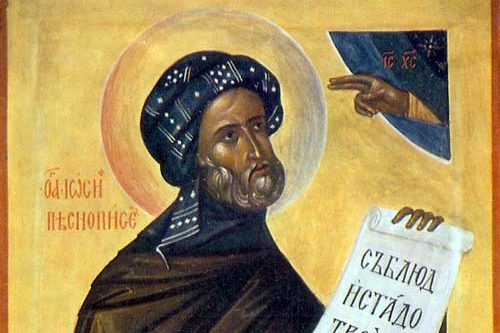
Saint Joseph the Hymnographer (c. 816–886 AD) stands as one of the most prolific and influential liturgical poets in the history of the Eastern Christian tradition. Known as the “Sweet-Voiced Nightingale of the Church,” his life was marked by the political and religious upheaval of the 9th century, including the Arab invasions of Sicily and the bitter theological conflicts of the second Byzantine Iconoclasm.
Joseph was born in Sicily around 816 AD to devout parents, Plotinus and Agatha. His childhood was cut short by the Arab invasion of Sicily, which forced his family to flee their homeland. They eventually settled in the Peloponnese of Greece. At the age of fifteen, Joseph’s inclination toward the ascetic life led him to the Latomos Monastery in Thessalonica. It was there that he was tonsured a monk and later ordained a priest-monk (hieromonk). His reputation for piety and his “rare character” caught the attention of St. Gregory of Decapolis, a prominent defender of the venerated icons, who invited Joseph to join him at the Stoudios Monastery in Constantinople.
The 9th century was a period of intense religious strife. The Byzantine emperors Leo V and Theophilus had revived Iconoclasm, a movement that sought to ban the veneration of religious images (icons). Because of his vocal defense of Orthodoxy, Joseph was sent by Gregory to Rome in 841 AD to seek the support of the Pope.
However, his journey was interrupted by tragedy. While en route, Joseph was captured by slave-trading pirates and sold as a slave in Crete. He spent several years in captivity, where he became a source of strength for his fellow prisoners. Tradition holds that on the night of the Nativity in 820 AD (though dates vary by source), he received a vision of St. Nicholas of Myra, who provided him with a mystical scroll to eat, symbolizing the gift of hymnography. Shortly thereafter, his chains reportedly fell off, and he was miraculously transported back to Constantinople.
Upon his return, the persecution of icons had ended under the Empress Theodora (842 AD). Joseph founded a monastery dedicated to his mentor, Gregory of Decapolis, and began his most productive era. He was appointed skeuophylax (keeper of the sacred vessels) at the Hagia Sophia by Patriarch Ignatius and later served as a spiritual father and confessor under Patriarch Photius. Photius famously described him as “a man of God, an angel in the flesh, and a father of fathers.”
Joseph is credited with composing approximately 1,000 canons—lengthy, complex liturgical poems. His work completed the Octoechos (the Book of Eight Tones), providing hymns for nearly every day of the liturgical year. Some of his most notable contributions include:
- The Canon of the Akathist: A majestic ode to the Mother of God.
- The Lenten Triodion: Hymns that guide the faithful through the period of Great Lent.
- Canons to St. Nicholas and St. Bartholomew: Written in gratitude for his liberation and spiritual guidance.
His style is characterized by a “wondrous pleasantness of sound” and deep theological insight. Many of his works have even been adapted into Western hymnody, such as the popular Protestant hymn “O Happy Band of Pilgrims.”
Joseph died of old age around 886 AD. According to his biographer, John the Deacon, his passing was marked by a vision of angels carrying his soul to heaven, accompanied by the very saints he had spent his life glorifying in song. He is commemorated on April 3rd (and April 4th in some traditions).
As someone who writes poetry and loves music, I find St. Joseph’s story and his music fascinating. He was both prolific and talented, possessing a gift that compels the soul to look heavenward. The enduring nature of St. Joseph’s hymns stands as a testament to the truth of God’s Word and His faithfulness to us. I am grateful for the poets who are now a part of the “Great Cloud of Witnesses.” Though they live in glory, their presence is felt in every poem I have written.
 LogoSophia Magazine