

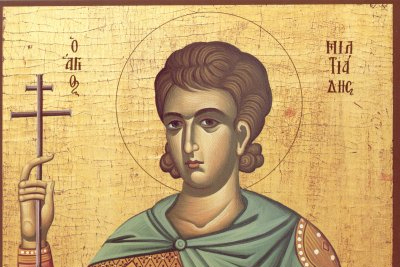
By Ian Wilson
Nothing is known about the upbringing St. Miltiades. We know that he came from the Roman province of Libya in modern day North Africa. But his reign as Pope of Rome was marked by change.
His Papacy began in the year 311, ending a period of vacancy after the exile of Pope Eusebius. It was the final days of the Persecution of Diocletian, the most severe of the Roman persecutions. Christians everywhere had their property and rights taken away by the Empire, for the crime of defying the imperial cult. This was a period of intense hardship for the Church, and many left the faith as a result of the intensity of the persecution.
But a change was coming. In 312, Constantine the Great, defeated his chief rival Maxentius, and ascended to the throne as Emperor. He attributed his victory to conversion experience he had prior to the battle, in which he acknowledged Christ as his lord. In February of 313, he signed the Edict of Milan, which granted Christianity full legal status in the Roman Empire, allowing Christians to practice in peace.
All of the property that had been seized by Diocletian was returned to the Christians, and all those in prison were released. In addition, Empress Fausta gave Pope Miltiades the Lateran Palace, which would be the principal residence of all popes from the fourth century on.
However, all was not well in the church; a schism was brewing in North Africa that threatened to rock the young church. Donatus, a bishop of Carthage, asserted that only those in a state of perfect grace could administer the sacraments. The Donatists believed that any form of mortal sin disqualified clergy from administering baptism and the Lord’s Supper. This was partly born of an overreaction to traditores– bishops and priests who had handed over sacred books and articles during the persecution rather than face martyrdom. Once the persecution ended, these were allowed to return to the church after confessing their sins.
The Donatists were outraged by the “scandalous” return of these traditores who had so violated the faith. Donatus required all of them to be re-baptized in order to return. In essence, they rejected the inherent validity of the sacraments, believing that they depend on the moral perfection of those administering.
Most clergy at the time rejected this view, believing that the sacraments were valid because Christ had ordained them and did not depend upon the perfection of the ministers, as no one is totally sinless.
In 314, Constantine chose to intervene– the first time a Roman Emperor would ever do so– and called a council at the Lateran palace to decide the matter. The Donatists rejected the whole idea and refused to even appear at the council, which allowed Pope Miltiades and his bishops to rule against them. The Donatists would not go down without a fight, appealing directly to the Emperor, who called yet another council in Arles to decide the matter once and for all. Once again, the Donatists were declared schismatics. Unfortunately, Pope Miltiades had fallen ill by this time, and passed from this life before he could attend the council.
His trial was not yet over, however; Miltiades was accused of apostasy by contemporaries. But Augustine of Hippo, the great theologian and philosopher, argued for his innocence, and he was declared a saint.
May we, like St. Miltiades, weather the storms of our times with grace and patience.
 LogoSophia Magazine