
By Ian Wilson (Rated G)
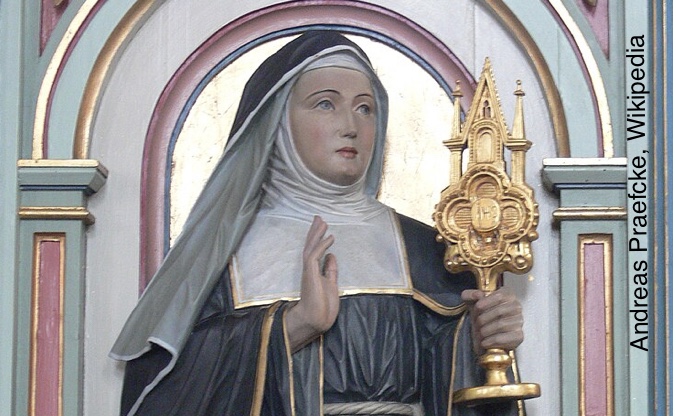
The pious nun Juliana of Liege was born in the principality of Liege, what is now Belgium, in the year 1191. When she and her twin sister were orphaned at a young age, the two were taken into an Augustinian convent and raised by nuns. She grew very devout, and had a deep veneration for the Blessed Sacrament.
In her youth, Juliana had quickly learned Latin and memorized the works of St. Augustine and St. Bernard of Clairvaux, devoting herself to theological study; an unusual pursuit for a woman in her time. At the young age of 13, Juliana was welcomed into the order. She was regarded as highly virtuous and eager to study.
In your teens, Juliana began to have visions while praying before the Blessed Sacrament. Not wanting to draw attention to herself, Juliana kept these visions private. In the visions, she was told by the Lord that there was a need for another feast day in the church calendar, a feast to draw attention to the Eucharist. She, however, was in no position to establish a new feast.
After Juliana had been appointed abbess of her convent, she made her visions known to her confessor, Canon John of Lausanne, who had some very powerful friends in the church hierarchy. Finding nothing contrary to the Catholic faith in her request, the men established the feast of Corpus Christi (The Body of Christ) as an official holy day. However, it did not become a universal feast until after Juliana’s death.
In addition to her role in the feast of Corpus Christi, Juliana also had a strong reform mindset, and made it her mission to restore the Augustinian order to its former excellence. This reform mindset brought her into the line of fire. She endured much hardship from her superiors, and often found herself on the run, staying as a guest at various convents and monasteries. She spent her final days with the Cistercians at Fosse-la-Ville. She died adoring the Eucharist on April 5, 1258.
Jacques Pantaleon, the archdeacon of Liege, was one of Juliana’s greatest supporters, believing her cause in establishing a new feast to be right. He eventually became Pope Urban IV, and established the feast that Juliana had championed. Many of the prayers and songs for the feast were composed by the great St. Thomas Aquinas.
May we act with conviction like Juliana of Liege, refusing to give up, even when we do not see our plans come to fruition.


Amen. Thank you. I wish I had her courage.
LikeLike