

By Cordelia Fitzgerald
Catholics have been criticized for being focused on “smells and bells” to the detriment of their worship, but there is one “bell” that they share with all Christians that should not be overlooked, and should, in fact, be expanded.
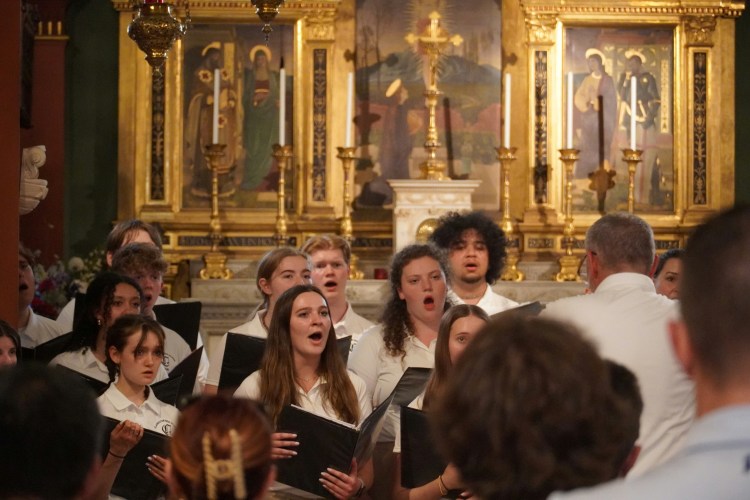
I speak of singing.
Reference will be made to this podcast (1), so I will introduce it here. The guest of the episode, Paul, speaks of his project to bring the Liturgy of the Hours to everyone in an accessible way and in the intended way – by chanting it. The Divine Office is an ancient Christian practice that was integral to everyday life for much of Christendom. One thinks of the peasants of the Middle Ages who, in the absence of common clocks, told time by the Hours: after Lauds, before Vespers, at Compline… The Hours were the schedule ordering the day, and even in modern times, the practice is continued in convents, monasteries, and rectories.
It is not, however, exclusive to them. The Divine Office is, as Paul explains, the prayer of the people, and it is available for all to participate in, that anyone anywhere in the world can be unified in prayer with their fellow Christians. “For where two or more are gathered in My name,” Christ says, “There will I be.” If we are gathered around the world in His name, then there He is – in the whole world.
Yet we were on the topic of singing.
Singing the Divine Office is accessible to all Christians; it entails little more than chanting some Psalms. It can also let in anyone who cares on the secret of Catholic accessories: the smells and bells exist because we are souls and bodies. We are made in the image and likeness of God, and that image includes the bodies that resemble the animals’. God also made the animals and saw that they were good. Therefore, it is important to not only look to the soul’s disposition in worship, but also the body’s.
Singing is a bodily participation in worship that does not lend itself to distraction. I can get distracted just reading the Bible; I wander off and wonder where I was when I recite or read aloud; but it is terribly hard to get distracted while singing, for when distraction comes, singing stops. It is done in the cycle of the breath, tuning the autonomic system to worship. It lifts the voice above the mundane mutterings and guttural tone of the everyday, lifting to God. It might even involve movements such as bowing for God’s glory: “Glory to the Father, and to the Son, and to the Holy Spirit…” For when we perform liturgical motions, we are engaging all the senses in that worship. We give God our sight as we see images of His life; we give God our smell when we inhale that incense that signifies the burnt offerings and prayers we offer; we give Him our touch when we make the Sign of the Cross upon ourselves as a physical remembrance of His Redemption; and we give God our taste when we eat the “fruit of the earth and work of human hands…[that] will become for us the Bread of Life” (2). Though these are not all present in the chanting of the Hours, we have nothing else of our bodies to give in prayer. Through our doubled attention from chanting we can, as St. Augustine is supposed to have said of singing, pray twice.
The point is that engaging more of ourselves (mind and body) not only deters distraction, but presents more in gift to God. This is something all Christians can do, and it acts as a great unifier where divisions might exist. All it takes is a voice and some Psalms, which most have. I won’t make the complete case here as to why the Divine Office should be sung and not recited, as this is the topic of the linked interview, but I will sum up my supporting thoughts to his argument: 1) smells and bells are tools to engage the whole person, body and soul, in the worship of his God and 2) while Catholics do this famously, it is not and should not be exclusive to them. It can be shared in a way friendly to most denominations by participation in the Divine Office.
Sing to the Lord!

