

By Anthony Cirilla
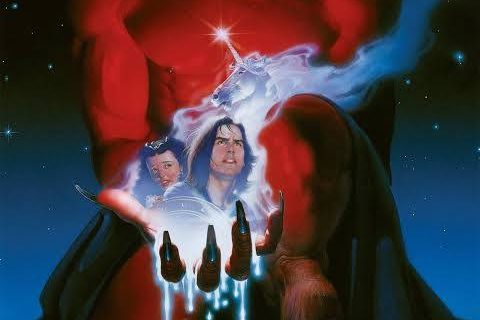
Forty years ago, the story of how Jack and Lily endangered and then rescued the last two unicorns from the Lord of the Underworld brought an elegantly simple wisdom to the silver screen. This essay explores how the love that unites Jack and Lily resonates with the quest for transcendent light described by Boethius in his Consolation of Philosophy.
“Do you think you can upset the order of the universe, and not pay the price?!” asks Honeythorn Gump, leader of the fey world, in an outrage as he learns that Jack has led his paramour, Princess Lily, to the presence of the last two unicorns, and, worse, she touched one. “You risk your immortal soul,” Jack had warned Lily at the time, and yet he had himself made the temptation possible by leading her to see their transcendent procession through a forest-brinked river. Due to Lily’s actions, and Jack’s part in them, the loathsome goblin Blix, hidden with his fellow goblins at his side, poisons the stallion even as it tenderly nuzzles her hand. The creature bucks and bolts in fear, which Lily misinterprets as mere animalistic flightiness, despite Jack’s misgivings. Worse, Blix hunts the stallion down and, with disturbing relish, rends asunder its alicorn (the unicorn’s horn), unleashing upon the forest a sudden wintry cold snap reminiscent of the frozen Narnia in The Lion, the Witch, and the Wardrobe. When Jack later communes with the mare, he learns that these events have cursed the forest (and possibly the entire world) as long as the stallion’s horn remains severed. Like the folkloric Fisher King of Arthuriana whose woundedness sickens the land, the stallion lies in deathlike stasis with the mare vulnerable and alone due to the permissiveness of Jack who precipitated Princess Lily’s transgression.
Jack’s response to Gump’s rebuke, then, seems somewhat weak: “I did it for Lily. I did it for love.” An immature dalliance that leads to, as Gump puts it, “a world locked in a season of death” hardly seems like a suitable motivation for creating the conditions for a temptation that could unmake the world (which becomes even more likely as Blix and Pox put the mare and Lily into the hands of the Lord of Darkness). Gump’s response to Jack seems surprisingly forgiving: “Love, you say? Well, love is another matter.” Is it? In fact, what else might Gump have thought would motivate Jack anyway? Of course, Gump’s sly look as he asks, “Did nothing untoward happen?,” suggests that he suspects the answer, but seeks to draw Jack’s confession. And when Jack confesses, Gump responds by having the leprechaun Brown Tom share some of his best fairy beverage, elderberry wine, almost like serving Holy Communion after the sacrament of confession. Why would a confession of love merit such treatment?
Jack’s Love and the Light of Virtue
We must ask what Gump thinks Jack means by love, and if that commendable meaning bears out in Jack’s character throughout the story. It must be a sort of love which merits remarkable sympathy, a love respectable even when on its account a law of the universe so high has been broken that it overturns the proper functions of Nature and leads to the transgressor, Princess Lily, being kidnapped to the Underworld. Boethius, in his retelling of the Orpheus and Eurydice myth, has a reaction akin to Gump’s. In that myth, Orpheus, like Jack, has before him the hopelessly daunting task of retrieving his beloved from the land of the dead. The music of Orpheus is so beautiful that it, like the effects of the unicorn’s shorn alicorn, can cause nature to reverse its courses: “He who before had made the woods so nimbly run/And rivers stand/with his weeping measures” (307). In response to his music, the gods agree to let Eurydice follow Orpheus out of the Underworld on one condition:
“We grant the man his wife to go with him,
Bought by his song;
Yet our law restrict the gift,
That, while he Tartarus quits,
He shall not turn his gaze. (Boethius, The Consolation of Philosophy 309-311)1
Hades of Greek mythology perhaps has more pity than the more purely demonic Lord of Darkness in Legend, though one wonders if the terms were perhaps intentionally set to doom them – for how could Orpheus, as he leads Eurydice out of the Underworld, not compassionately glance back if she shrieks out in fear? Boethius comments,
Who can give lovers law?
Love is a greater law unto itself.
Woe! By the very boundaries of Night
Orpheus his Euridice
Saw, lost, and killed. (Boethius, 311)
Boethius understands that while authentic love is not the highest good, it models it at such an elevated tenor that such love poses a powerful temptation to confuse with transcendence itself. So Boethius uses the tale to caution us against the peril of idolatry in any of our loves:
To you this tale refers,
Who seek to lead your mind
Into the upper day;
For he who, overcome, should turn back his gaze
Towards the Tartarean cave,
Whatever excellence he takes with him
He loses when he looks on those below. (Boethius, 311)
Indeed, Jack lost Lily to the Underworld the moment his love for her exceeded his commitment to the very source of transcendence that both manifested in the sacramental creatures of legend and in his own dearly beloved.
Yet, Jack, unlike Orpheus, does not fail in the end. Perhaps this result in the story gives us a glimpse into what Gump heard when Jack professed his love. Orpheus was no mere lover – he was such a true lover of Eurydice (indeed, her husband) that he sacrificed all to attempt to bring her back. If Jack loved Lily at least as much as Orpheus loved Eurydice, then Boethius would give him sympathy, and even respect for his attempt to save her. But Jack did not fail, and perhaps that vindicates Gump’s interpretation – that Jack loved Lily with a virtuous heart filled with belief in her goodness. Of course, Princess Lily is beautiful, but if by love Jack simply meant he found her attractive, Boethius at least would not be impressed:
And if, as Aristotle says, men enjoyed the use of Lynceus’ eyes so that their sight penetrated obstacles, would not the superficially very beautiful body of Alcibiades seem most vile when his inwards could be seen? So it is not your nature that makes you appear fair, but the weakness of the eyes of those who look at you. (Boethius, 261)
Physical beauty, as a material manifestation of harmony, has its best value in its ability to symbolize a deeper harmony – the beauty of a soul oriented towards virtue (hence characters in Legend who may not be beautiful outwardly, and to some might even appear somewhat unattractive, are nonetheless treated as good). By love, Gump may suppose that Jack does not mean mere sensual desire but a love for the virtue he believes Lily has, a love which generally governs his attitude towards her in a properly oriented way – even if he cannot perfectly sustain that orientation all the time (such as when he urgently whispers “No, you mustn’t” to Lily as she approaches the unicorn rather than attempting to prevent her altogether).
Jack’s orientation to Lily as one rooted in virtue has its proof even in his desire to show her the unicorns, a desire that does stem from a wish to please her but also because he believes they, together, will be able to appreciate the manifestation of cosmic harmony embodied by the unicorns as well as their love. Boethius learned from Aristotle to regard friendship as a mutual orientation towards virtue: “but the most sacred kind of good is that of friendship, a good reckoned not a matter of fortune but of virtue, while any other kind is chosen for the sake of power or delight” (235). And Boethius clearly asserts this definition applies to a wholesome marriage: “Then again, your wife lives, a good woman excelling in modesty and propriety and–to sum up all her gifts in one phrase–a woman like her father” (191-193). Unicorns are more than the property of virtue in this world – they are a sacramental ordinance which places the Light that orders the universe into an outward and visible form, according to the theatrical version’s opening scrawl: “But precious light is protected, harbored in the souls of the Unicorns, the most mystical of all creatures.” Something like Aulë’s desire to make the Dwarves in The Silmarillion, Jack’s desire to share the presence of the Unicorns is misplaced but not fundamentally perverse or rebellious. It is, rather, an immature but well-meaning attempt to participate with Lily in the orders of cosmic love.
1In this article, I use the Loeb translation of The Consolation of Philosophy, trans. H.F. Stewart, E.K. Rand, and S.J. Tester, 1973. This edition also contains Boethius’s theological tracks; for readers interested in the Christian faith of Boethius, tract 4, “De fide catholica,” is especially valuable.

