
By Ian Wilson
[Originally published in Legends and Songs: The Newsletter of Ian Thomas Wilson]
I think many, if not most of us are aware of Jordan Peterson’s 12 Rules For Life. Which, admittedly, I have not read yet, but it’s on my list. But we all know that. I have my own set of rules for how I run my life, and what I allow myself to write.
But maybe you’re wondering what those standards are, exactly. Well, here are my 12 rules for writing adventure stories. Feel free to follow, or discard them at your own convenience, whatever fits your writing style. I’m not telling you what to write; I’m just telling you how I write a book.
1. If Edgar Rice Burroughs wouldn’t write it, I shouldn’t either
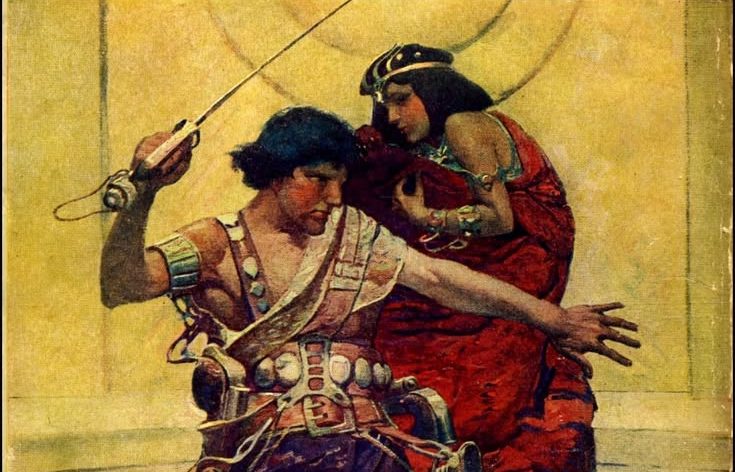
I consider Edgar Rice Burroughs to be the best adventure story writer of the 20th century. He influenced generations of writers, both for books and TV, and young men in general who went out and did something with their life. He was a pioneer of Science Fiction, and I try to emulate his work whenever I can. Therefore, when deciding what’s “too edgy” I ask myself “What would ERB do?” and I do that. This has been a guiding principle of my writing career.
2. Avoid “grayness”
It’s a trend nowadays to make everything morally gray. I greatly dislike this trend. I’m not saying the hero must lack “grit”— that’s simply laughable. Every real hero has some grit. I’m not talking about the perfect “boy scout” here. I realize that in the real world, there aren’t always simple “good guys” and “bad guys”. Sometimes there is grayness, and messiness; sometimes things aren’t as simple as we’d like, but I’ve seen evil and I’ve seen goodness, and I want to point people toward the good in my writing. I, like Sylvester Stallone, want to give people someone to root for. Which leads to my next point:
3. The hero must never be boring
Like I said, I don’t like perfect boy scouts. Every truly good man has done something bad, or is at least capable of doing bad things. I’m talking about Jack Reacher, the Man with No Name, Doc Holiday, the Punisher. The hero is a villain who keeps it in check. They must be exciting and interesting enough that the audience is captivated with them. They must be virtuous enough that you can distinguish them from the villain. The hero does what he believes is right, even if it’s hard, even if it means killing his opposition. Heroes bend the rules to make them straight, if that makes sense. That’s why they’re so hard to write. The villain must never be more interesting than the hero.
4. Redemption arcs are good to a point
When I wrote my Walter Ulric stories, I purposefully wrote a “redeemed monster”. Walter has done some terrible things, but he is trying to make it right. He’s seen evil and he’s seen good, and he wants to avoid the evil. However, he’s got enough evil in him to do what’s necessary. That’s why he’s interesting.
I love redemption arcs for this reason. I believe there’s hope for everyone to turn around and do what’s right. Call it naivete, but it’s what I believe. That being said, don’t overdo it. There’s a point at which the audience is expecting the villain to be defeated, the dragon to be killed, the black hat to get it in the shootout. Don’t disappoint them every time.
5. Sympathetic villains are overrated
Which brings me to my next point, sympathetic villains are overused and overrated. Sometimes they’re good; Mr. Freeze, for example, or Clayface. They make you feel sorry for them, but Batman still has to stop them. This causes a conflict in the audience member that makes the story all the more interesting. However, use them sparingly. Pepper is good, but you don’t want to overdo it.
6. No flat women!
Got your attention there, didn’t I? This ain’t that kind of blog.
I cannot stress how tired I am of one-dimensional women, both damsels in distress with the personality of wallpaper paste, and fake girl-bosses with the personality of sandpaper. It’s too much! In our haste to distance ourselves from the damsels in distress, we created the girl-boss who is just as bad. In reality, you need a well rounded female character, one who can be tough and take initiative when necessary, but also can be soft and vulnerable. One who can be rescued, but can also rescue herself when the occasion strikes. She needs personality! Even if she’s your main character, your heroine, she needs to have moments when she’s vulnerable. Even a heroine needs rescuing from time to time.
7. Excitement in every chapter!
If I could give any author advice it would be this: don’t waste a single chapter! Add some excitement! Danger! Drama! Suspense! This is why people come to read your books. Don’t bore your audience with boring, ponderous chapters. Throw in an exciting twist, or a little detail to wet their appetite for adventure!
9. Purple Prose Perfects Paragraphs
There’s a lot of criticism of “purple prose” out there, and yes, you can overdo it, but that doesn’t mean you shouldn’t use it at all! Purple prose, by the way, is prose that is overly verbose, elaborate or ornate. Sometimes I refer to it as “baroque English”. H. P. Lovecraft was a master at it, using words like “styggian” “cyclopean” or “Charnel” with wild abandon. Like I said, you can overdo it, but a little purple prose here and there makes your paragraphs more interesting.
10. Make every sentence worth it
Don’t waste the reader’s time with meaningless sentences. Make them all worth it. Make them relevant. Make them interesting. Make them funny. Make them sad. Make your audience yearn for more!
This is the thing I love about Dean Koontz and why I can’t get enough of his stories; he never wastes a single sentence. All of them matter. All of them have meaning. All of them burn with life! Reading him is a feast for the imagination!
11. Cliff hangers!!
This goes along with point 7. Try to close each chapter with a cliff hanger, to make your readers beg for more! Make them long for the next one! Make them stay up until 2:00 AM reading! This is one of them things that both Edgar Rice Boroughs and Dean Koontz do well.
12. Don’t be weird
No one cares about the bathroom habits of elves. No one wants to know how halflings get it on, except for perverted weirdos. No one — except for perverts— wants some kind of weird dwarf orgy. Yes, I’m taking shots at specific authors. You know who you are. Don’t gross people out. Just share what the audience needs to know, and get on with the story!
So what about you? Do you have any rules for what you will or won’t write?

