
By Amanda Pizzolatto (G)
In this day and age, it seems many scientists, and non-scientists, are determined to prove the Bible as pure lies, or inspired by the mythos of surrounding civilizations. An interesting position to take considering that the mythos of a country is typically an exaggerated history of their people, using gods to explain the unexplainable. The Odyssey would fit this definition, yet no one denies that many of the events depicted in the Odyssey, like the battle of Troy, were factual. Why then is this different with the Bible, especially the Torah, or the Old Testament? Is the history of the Jewish people so unimportant that it must be proven to be false? While the history of the Greeks, Romans, Chinese, Zulu, Cherokee, and many others are far more important, yet still contain many such similar myths? It reveals a selective bias, one I had thought we all swore to leave behind in the ‘40s, concerning scientific research. I think many of us know the answer to that as, if found true, would have to face some uncomfortable questions. But even then, not everyone believes the truth, even with it standing right in front of them, so I don’t think many people will have to worry about that. That is ultimately their decision and their decision alone. However, one man was eager to find the truth regarding the Exodus and took a team in search of archaeological evidence to prove that it happened. The results are documented in the documentary The Exodus Decoded*, hosted by Simcha Jacobovici and produced and co-hosted by James Cameron.
The team began with the Ahmose Stele, a tablet telling of a great storm and a semitic people leaving the land of Egypt. Other details emerge that coincide with details in Exodus, with the team coming to the conclusion that the Exodus took place during the reign of Ahmose, not of Ramses as previously believed. This is further cemented by the fact that the name “Ahmose” literally translates into “brother of Moses,” and even further when it is found that his eldest son died at the young age of twelve. With this in mind, they aim to look for more clues during the reign of Ahmose rather than during the reign of Ramses. That’s when another clue looms above the rest. Literally.
This next clue, while looming, could technically not be seen from Egypt as it was off the coast of Greece on the island of Santorini. There, the volcanic activity had been immense, and one day, it was so great that it could have been felt all the way in Egypt. Details in the Ahmose Stele point to this as certain indicators of volcanic ash clouds line up with what Egypt was undergoing at the time. Other indicators line up not only with the volcano, but also at its size, there is massive seismic activity set off by the volcano, called an earthquake storm. Recorded video of a similar situation in Cameroon at Lake Nyos in 1986 proves how the plagues could have happened with eerily similar plagues rampaging through the village.
After a big earthquake, gas leaks into the lake and makes the iron deposits found at the bottom rise to the surface, turning it red. Following that, any animals that are able to flee the scene, like frogs, flies, and lice, do so in search of clean water. Then came the pestilence on the livestock and boils. The volcano explains the next few plagues, the fiery hail, the descent of the locusts, and the three days of darkness. The final plague is confirmed by the events at Lake Nyos, the gas trapped by the lake water was disturbed by a landslide and became a fog that rolled across the land, suffocating anyone and anything laying low to the ground. Egyptian first-born lay on beds close to the ground, including Ahmose’s son, Prince Sapair, which would result in them being the only victims of this final plague.
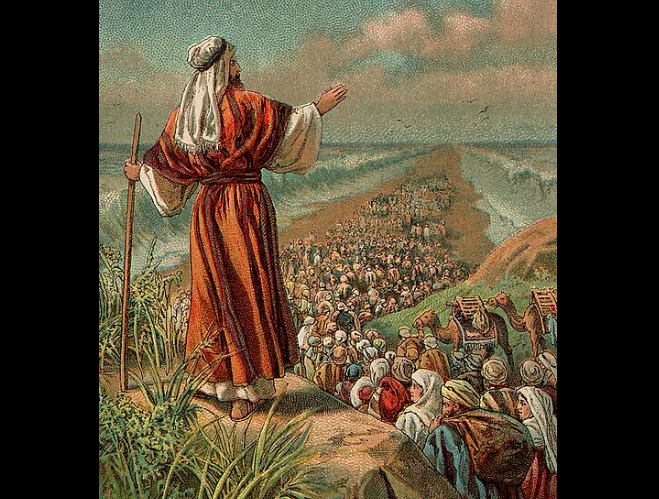
The seismic activity in the area is also used to explain the pillar of cloud and fire and the parting of the Red Sea. However, due to lack of archeological evidence found in the Red Sea, the team goes back to the Hebrew words used to describe the body of water they crossed and find that it was a mistranslation. The Hebrew words used actually mean Reed Sea, not Red Sea, which sends the team in a different direction, and they find a stone tablet that matches the description of the parted sea in the Bible. Not only that, it gives a name to the sea which, when translated from Egyptian into English, means “Reed Sea”.
This then leads the team to search for the actual location of Mount Sinai as the current popular location does not line up with the route the Israelite would have taken from the Reed Sea. They do find a mountain that fits the criteria, that of once having a natural spring, a natural auditorium, and a burial site. They continue to search further for one final piece, an image of the Ark. They believe they found it, in a piece of jewelry
Now, more is discussed in the documentary, but whether it is fact is another matter entirely. Unfortunately, the majority of what Simcha Jacobovici presents is a hypothesis, a very fascinating one, but a hypothesis nonetheless. Many mainstream archeologists do not accept it as fact, and Jacobovici admits he has no academic credentials. But isn’t that the point of research and using information that has been since revealed in the various studies, to find the truth? One doesn’t need to be a scientist to find the truth, and sometimes, scientists are wrong. Even this team could be wrong. But we might never know if no one tests the hypothesis. But if they are right, this then proves the might of God, using His own creation to bring about the results He desires. I understand that the knee-jerk reaction to using science to prove God’s miracles as an attempt to prove He doesn’t exist, but that’s impossible to do. Just because you know how something is made shouldn’t make the art any less astonishing. In fact, science has continued to prove how much of a miracle this whole planet is, but only those with the eyes to see will see that. Based on the evidence presented in this documentary, what do you see? What do you think? Would you follow their path and get the same results, or would you find something different? The documentary is available to watch on YouTube for free, if you’re interested to take a deeper look at their evidence and come to your own conclusion. After all, there’s only one way to find out.

