
Darkness and the Weakness of Evil
Darkness regards himself as a Manichean enemy of the Light, and the story’s framing supports this: “Then came the splendor of light, bringing life and love into the Universe, and the Lord of Darkness retreated deep into the shadows of the earth, plotting his return to power…by banishing light forever.” Boethius would see, however, Darkness as a maximal expression of evil as a privation, a power-hungry tyrant whose perverted will has chained him to his own wickedness:
Those lofty kings you see seated high on thrones,
Bright in their glowing purple, hedged in with bristling arms,
Threatening with visage stern, and gasping in the frenzy of their hearts–
If a man strip from those proud kings the cloak of their empty splendour,
At once he will see these lords within bear close-bound chains. (Boethius, 329-331) Looming, physically formidable, able to summon streams of fire from his fingertips and influence men’s dreams, Darkness cannot successfully woo a woman he thinks he loves, he cannot make a single friend (only command servitude), and he cannot walk outside during the day: “Yet all power is to be desired; clearly therefore, evil is not a power” (Boethius, 329). True happiness, contends Boethius, comes from virtue; Darkness, although he may exhibit diabolical mirth, is never happy in the film but often expresses his loneliness and even his sense of fear at the presence of the unicorns.
Another component of Boethius’ theory of evil is the way privation of the soul draws the individual down the chain of being into diabolical parodies of the animal kingdom. In Lady Philosophy’s song about animals themselves, like Lily’s, the animal kingdom is seen as a panoply of order, as each animal seeks its good from God’s creation. But creatures with powers of intellect, humans and angels, become inappropriately animalistic as they surrender their rationality to lower desires, as in the case of greed: “The violent plunderer of others’ wealth burns with avarice: you would say he was like a wolf” (Boethius, 335). Darkness tells Jack during their fight, where Darkness is clearly more dangerous as a fighter: “Even a wolf has fleas; ‘tis easy enough to scratch.” Likewise, Darkness finds himself controlled by his own temper, roaring with petulance reminiscent of Beast in Beauty and the Beast when he cannot get his lady to act as he wishes: “He that cannot govern his anger roars: let him be thought to have the spirit of a lion” (Boethius, 335). Blix as the chief goblin servant of Darkness fits the description of the fox, even appearing like a demonic version of one: “The secret trickster rejoices that he succeeds in frauds: let him be on a level with the little foxes” (Boethius, 335). Pox, likewise, has the face of a pig and is suitably voracious in his appetites, even speaking of drinking the marrow from Lily’s bones, of which Boethius says, “A man is drowned in foul and unclean lusts: he is gripped by the pleasure of a filthy sow” (Boethius, 355). Blunder, apparently the third goblin who turns out to have once been a companion of Gump and perhaps infiltrated the ranks of the goblins to undercut their plans as his antics seem to suggest, nonetheless has been effected by their ways, as one of his hands has become a chicken’s foot, perhaps having distorted his own nature as he has gone undercover: “The fickle and inconstant changes his pursuits: he is no different from the birds” (Boethius, 335). As Darkness proclaims that Lily will be his wife, she rejoins, “You disgust me. You are nothing but an animal!” Darkness laughs diabolically and says, “We are all animals, my lady.” Where the fairies have some animalistic qualities, this represents a harmony between the human and animal worlds; with Darkness, the two are fiendishly conflated.
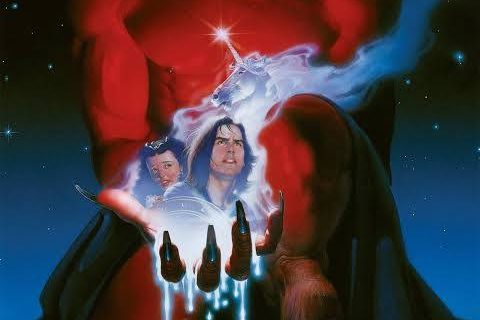
As a classic image of the demonic, an anthropomorphic bull with the fangs of a wolf or other predator, Darkness serves as a distortion of the image of God in the human form, where rather than exercising dominion over the animal kingdom he internalizes their carnal nature, distorting the biblical order, as Boethius puts it:
Other things are content with what is their own; but you men, like God in your minds, seek to bedeck your nature, excellent that it is, with lower things, and do not see how greatly you injure your maker. He wanted man to be above all earthly things; you men reduce your worth to less than that of the lowest… if he ceases to know himself he is made lower than the brutes. (Boethius, 205)
Ironically, his plan to destroy the unicorns will also destroy the forest life over which he desires control and in so doing wreak havoc on the very animal kingdom with which he claims to have so much in common. And in fact, Darkness’ own tyrannical plans prove to be his undoing, as he is impaled in the stomach by the alicorn he had taken from the stallion by Jack, exactly as Boethius predicted: “Knowing by experience the dangers of his own position, one tyrant likened his fears as king to the terror of the sword hanging over Damocles’ head” (Boethius, 251). In fact, this battle plays out in what should be the safest place for Darkness, in the presence of the mystical door to the Abyss, yet he is bested by Jack (with the help of Lily and the fairies) in his own home, similar to a story Boethius tells in his critique of power as the highest good: “We read that Busiris used to murder his guests, and that he himself was killed by his guest Hercules” (Boethius, 211). The horn of the alicorn is the piercing manifestation of the transcendent, reflected in the animal kingdom and driven forward by the hand of a bearer of the image of God, properly lodged into the tyrant’s stomach as a lance of light into the insatiable appetites of Darkness itself.
The Sacramental Quest for Cosmic Love
Before concluding, I wish to say that it is important not to read the film as a heavy handed expression of the Gospel. It is a more powerful support of the evangelium for that reason – it stands adjacent to the good news, much as Tolkien wrote his fantasy to do. “Legend and history have met and fused,” Tolkien wrote about the Gospel in On Fairy Stories. But the legendary truth must for all that be given sufficient breathing room apart from the theological truth to speak to that historical fusion. The fairies are important for this reason, because they represent the realization that meaning should not be tyrannically fixed by overbearing interpretation (the very role C.S. Lewis explained the Middle Ages gave to fairies in his Discarded Image). Their path leads neither to heaven nor to hell, according to Tolkien, but to capture a point of view true of this world. The heritage of Christian symbols (the unicorns, Darkness as a satanic figure, and the armor of God imagery, and even to an extent fairies as a medieval repurposing of Celtic myth) were chosen because they make a good story. But like Boethius, I think the good myths of the moderns, as well as the ancients, can often help us to love the Good Story more precisely because they were meant to be beautiful but turned out, in some respects, to also be true. And it is true that we, like Jack and Lily, are on a sacramental quest for cosmic love.
The two versions of the film, while similar in many respects, have differences which nonetheless, I think, reinforce the meaning of the larger mythos Ridley Scott presents. The surreal Tangerine Dream soundtrack, the greater emphasis on the romance between Jack and Lily, and the happy reunion and restoration of love between them at the end of the story emphasizes the theatrical release as a Sir Orfeo narrative – a fairy tale where Darkness is cast out by the light and human love mirrors the cosmic order of the universe. The earnest Jerry Goldsmith track, the emphasis on Lily as a singer whose innocent melodies draw the unicorns, Jack’s cunning against Meg Mucklebones, and the more uncertain ending where Jack and Lily are reunited as friends but are more cautious about their romance suggests they have learned a more palpably Boethian lesson that they were naive about the world, as the opening scrawl in the theatrical release asserts: “A beautiful girl named Lily loves Jack with all her heart. In their innocence, they believe only goodness exists in their world.” The theatrical release is the fairy tale and the director’s cut the fantasy novel, but they are drawn together by an adjustment unique to each version’s ending: while the plot is happier in its conclusion, the theatrical release is haunted by the laughter of darkness. Where the plot concludes more gingerly in its qualified optimism, the director’s cut nonetheless ends with the song of Lily to Jack: “Come down sparrow, sing me good morning. Rise up sun, like arch of the sky./Living river, turn light to diamonds/When I look in my true love’s eyes.”
The different elements of the two versions retexture the same meaning: that the sacramental quest for cosmic love will at best have an “already, but not yet” quality to satisfaction in this life. Darkness laughs, but Jack and Lily love and the unicorns dance again; Lily doubts but sings anyway. True love is in neither case merely sentimental, but dangerous, difficult, and therefore enchanting as true fairy tales are – not the maudlin things which pass by the same name. Outrageous evil faces human love, as it does in the lairs of Darkness where people cry out in tortured agony. Like the love of Jack and Lily, the unicorns remind us that the sacred must become vulnerable to be accessible to mortals. Unicorns whose coveted alicorns heal poisoned waters are drawn into danger by the bait of young virgin ladies, because they represent the healing power of Christ who came to take on mortal frailty of his mother the Virgin Mary even though he was God, so that Love could reign on Earth as it does in Heaven, as Boethius has Lady Philosophy teach:
What binds all things to order,
Governing earth and sea and sky,
Is love….
And love joins people too
By a sacred bond,
And ties the knot of holy matrimony
That binds chaste lovers,
Joins too with its laws
All faithful comrades.
O happy race of men,
If the love that rules the stars
May also rule your hearts! (Boethius 227)
When the unicorn’s horn is restored, sunlight is restored to the forest. When the Sacrament is taken, the Christian remembers that such wholeness has already been brought by Christ to the cosmos, though it has not yet been fully realized. Legend does not intend to tell an orthodox Christian story, but it does intend to convey the power of myth to confront darkness with light, which helps me as a Christian to feel a Christian truth more deeply – that I am, as the closing song by Jon Anderson and Tangerine Dream sings, “Loved by the sun,” or rather loved by the God who raises the sun that darkness can be swept from our eyes and from our minds. If the testimony of Christ, witnessed in Scripture and tasted in the Sacrament, is true, then the world is not so different from the one depicted in Legend, where demons tremble at the tramp of sacramental light processing through the earth.
Anthony G. Cirilla is Associate Professor of English at College of the Ozarks and Editor at Carmina Philosophiae: The Journal of the International Boethius Society. His forthcoming book through Davenant Press on Boethius is entitled The Citadel of Faith: Boethius’ Consolation of Philosophy and the Poetics of Perception, to be accompanied by a new translation of The Consolation of Philosophy, November 2026.

