

By Sarah Levesque Losardo
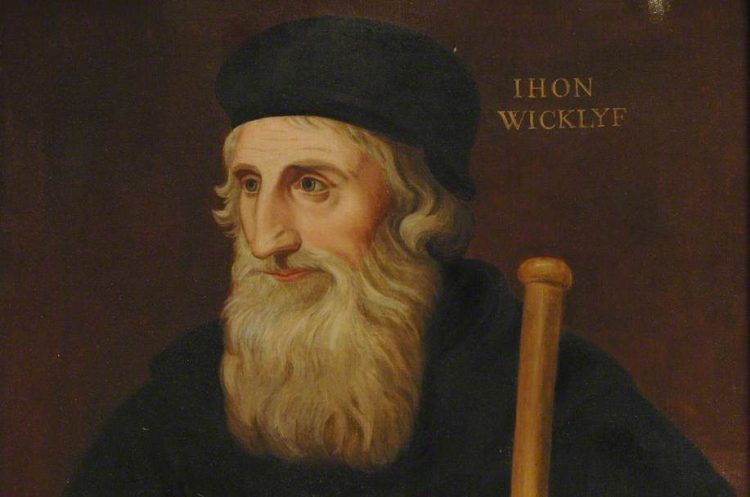
John Wycliffe, dubbed “The Morning Star of the Reformation”, was born around 1330 in Yorkshire, England. He completed his doctrinal studies at Oxford, where he gave a series of lectures commenting on the whole of the Bible. Eventually rising to the post of Vicar of Fillingham – Oxford’s most prominent parish – he became interested in politics, writing political treatises and representing England in a discussion with Rome about papal taxes and appointments to church posts. Wycliffe counseled Parliament and king against the right of sanctuary (which allowed a man to take sanctuary from accusers in a church), and that it was lawful to keep Rome’s expected portion from the Pope, incurring the wrath of the papacy, though due to his influence, Wycliffe remained free despite Pope Gregory XI directly calling for his arrest. Wycliffe wrote a good deal about how those in sin did not deserve to be in power – including the pope – and became an advocate of church reform, attacking abuses of all sorts at all levels, particularly the worldliness of the clergy. Indeed, the problems with the church were great, as Rome was awash with priests and cardinals who were uninterested in their eccesial duties and multiple successive popes were either spineless puppets or merely interested in temporal and political power. Wycliffe accused the papacy of being the Antichrist, rejoicing when the Great Western Schism saw two men claiming the papacy, causing much division, which he hoped would negate the power of the Bishop of Rome.
Unluckily for Wycliffe, his political patron (John of Gaunt) lost favor in the English court and became unable to protect him from those who Wycliffe had upset. Subsequently, in 1381, Wycliffe was banished from his beloved Oxford and took up residence in Lutterworth, Leicestershire, where his criticism grew from clerical abuses to the doctrine of the Catholic Church, particularly the superiority of the Church who compiled the Bible over the God-breathed words of Sacred Scripture. Wycliffe’s teachings on grace became a stepping stone for the later Protestant Reformation. The following year (1382), his teachings were condemned by a council meeting in London.
He upheld the spiritual power of the Eucharist and the sacramental understanding of it as the Body of Christ while trying to break people of their superstitious, magical understanding of it, though he taught that the bread stayed bread and the wine stayed wine. He also campaigned for the Bible to be translated into the vernacular and made available to all. This endeavor, completed by Wycliffe’s followers after his death, must have been a colossal feat in the days before the printing press (invented in 1440), not least of all due to lack of uniform language and lack of literacy of the common folk. Meanwhile, Wycliffe sent men throughout England to preach the Bible’s message through Wycliffe’s lens. These common folks, many of whom had only a little education, were given the demeaning title of “Lollards”, meaning “mumblers”, and were persecuted by bishops.
It seems in all his works, Wycliffe was sincere rather than calculated, earnestly desiring reform. In the end, he died of natural causes on the last day of December, 1384, in Lutterworth. His followers went on to publish two translations of the Bible in English (from Latin) in the decade after his death, both becoming known as “Wycliffe Bibles”. Later, in 1415, the Council of Constance formally declared forty-five of Wycliffe’s teachings to be in error.
May we, like John Wycliffe, be dedicated to preaching the message of the Bible to the best of our ability.
Sources:

