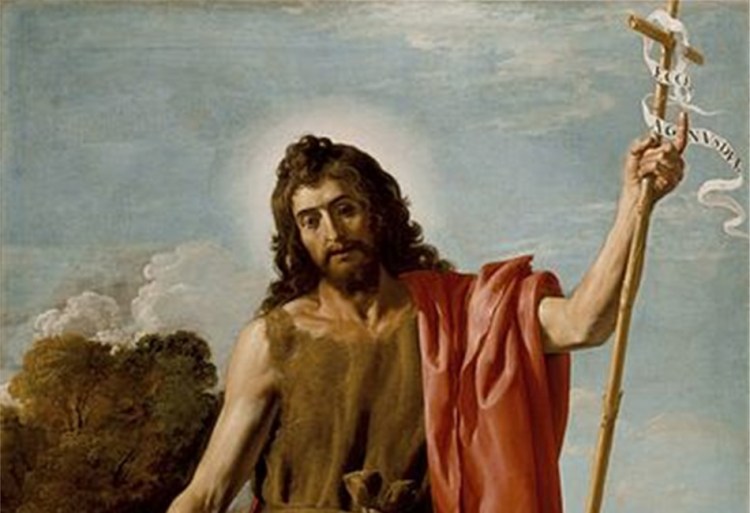
Saint John the Baptist, a man not shaken by the wind, a man not dressed in the finery of the palace, eater of locusts. Well, that last one doesn’t sound quite as impressive, but he did eat locusts as well as whatever he could find in the desert near the Jordan River. He lived the life God called him to live, and he lived it well, so he has a feast day in the Calendar of Saints….
Have you noticed that despite all speakers’ efforts, graduation speeches sound very much alike? “Keep the torch alive to pass to a new generation with the key that unlocks the road to the future…”
One of those Ancient Greek philosophers – Aristotle, maybe – said that there were three types of friendship. Whatever he called them, I’m going to call them the Fun Friend, the Useful Friend and the True Friend.
Each of us has a place inside, deep inside our inmost being, hidden away from prying eyes and mocking words. It is a place of snowflakes and bubbles, of hopes and fears. It is a place in which one wrong move means catastrophe…
The big V Vocation is our ultimate call to one of the three following categories; religious life, married life, or consecrated single life. In order for us to discover complete fulfillment in life, a desire with which each individual is born, we must open our hearts to God’s whisper.
Life, death, rebirth. These themes are revisited every year when the flowers bloom again, filling the world with color, like a rainbow had walked through the melting snows. The image of a stone rolled away from the mouth of a cave circulates the web in honor of the Resurrection of the God-Made-Man. And it’s not just in the memes that circle around the world, it’s also in the tales that are such an important part of our libraries, and our imaginations.
The Easter Bunny is hiding brightly-colored Easter Eggs for the children, a tradition brought to America from Dutch immigrants, though the now-famous bunny originally began as a fox. But what about other countries? Not everyone celebrates Easter the same way, because no two cultures are exactly the same. But that’s the fun of it.
Churchmen everywhere emptied out from their sermons such abhorrent things as doctrines and definitions, they got rid of “all that ritual nonsense” that the fast-moving modern couldn’t stomach – in short, they tried to bring back the common man by meeting him halfway. What they actually did was to confirm him in his skepticism by offering a second-rate relativism which neither satisfied his taste for fashion nor reignited in him an actual love for truth. Religion, it seemed, capitulated to the fads of the world.
“You go to Taco Bell, and if you don’t want a Coke, you want ‘just water.’ Just water? JUST water?! It’s the whole reason you’re alive, but it’s free, so you treat it like it’s nothing!”
My friend was on to something.
Today’s first lesson is that no such construct as “homeschool” exists, either as a noun or as a verb. When your father taught you hunting safety he did not homeschool you; he taught you. If your sixth-grade teacher taught you not to spit tobacco into the classroom litter basket because your parents failed in their duty of teaching basic hygiene, manners, and dignity, he did not schoolhome you.
James Lee mentioned that he really liked Kristin Hannah’s novels, which I pooh-poohed as chick-lit. He assured me that they are really good, and that with my love of Russian literature I would appreciate Winter Garden, parts of which are set in Leningrad…
Recently I finished a book only half-remembered from my youth, Yevtushenko’s A Precocious Autobiography. I had no idea that a poet I had long admired was such a phony.
Where has the love gone, the magic that everyone associated with Christmas? Is it because we insist that the world should be devoid of the love that Jesus Christ brings in the manger, that it should be devoid of the wonder and magic that Santa Claus brings down every chimney?
All around lays a gentle silence, as if the world is holding its breath in anticipation of a momentous occasion. In sharp contrast to the silence, cold, and darkness is a church all aglow with the light of several candles as voices raise in joyous song. Jesus Christ has been born!
What is it about Christmas music that can steer our emotions so effectively? Sure, all music can do this, but I feel it most deeply with Christmas music…
Mr. Frost crafts smooth, flowing iambic tetrameter and iambic pentameter, sometimes rhyming but sometimes not. That he makes rhyme work so well demonstrates the excellence of his art; there are only five – arguably six – vowel sounds in English, which rhymed through the pen or keyboard of a learner usually ends in clunkiness or unintended comedy.
“Hail Mary, full of Grace, the Lord is with thee”. Thus begins one of the most well-known, and possibly most debated, prayers in the history of the Church.
I was thinking about Monty Python and the Holy Grail in all its ridiculous glory when I realized that similar skewed logic is used all the time in the real world, as if it were true logic. The conclusion seems sure before the argument, and as often as not, it is to the detriment of others.
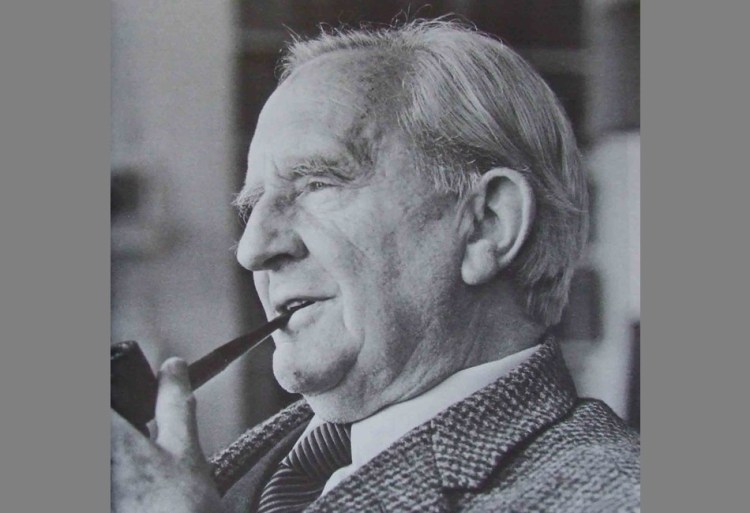
J.R.R. Tolkien, a Biography by Humphrey Carpenter is a nice little biography for those who love Tolkien and the Inklings. Humphrey Carpenter’s several biographies are always well-researched and, even when alluding to awkward moments in the subjects’ lives, infinitely kind and generous.